Winner of the Palme D'Or at Cannes and sweeping many other prestigious festivals worldwide, the Romanian drama "4 Months, 3 Weeks and 2 Days" found international attention and almost unanimous acclaim. Its pertinent and timely issue of abortion, and the themes director Cristian Mungiu structures his story around it, may be one of the factors of its recognition. Just as likely could be its setting in Communist-controlled Romania, and the consequences of a strict dictatorship on laypeople.
Or, people could have just responded to the film's unpredictable and quietly intense narrative. Using an observational style similar to the the Dardenne brothers, ("L'Enfant") Mungiu lets effective long shots and ordinary dialogue build the story arc. It's amazing how quickly his realistic visual approach takes a grip on the viewer, thus allowing the heavier plot elements arise naturally and without melodrama.
The handheld cinematography and realistic plotting are nothing innovative, but they are used so perfectly that a better approach to the story seems unimaginable. Everything about the movie feels intensely real, and the objective way Mungiu deals with the subject matter forces the viewer to contemplate the many messages far after the film is over.
Wednesday, June 18, 2008

The Rapture

Michael Tolkin shone brilliantly with his delirious, insatiably experimental screenplay "The Player," (adapted from his novel of the same name) which used a big name movie producer to exemplify the worst of material excess and Hollywood ego. Robert Altman's film plays as a descent from a high-flying career into the darkest depths of human emotion, then into a sort of failed rebound, but inevitably back into pained realization. It was a unique, fully-immersive show biz satire that was topped only by David Lynch's masterful couplet of "Mulholland Dr." and "Inland Empire."
For his first feature film "The Rapture," Tolkin picked hot-topic religious issues as his springboard for cultural and social criticisms. Right off the bat, he picked a steep hill to climb. Religiously-themed movies, regardless of what they say or how they say it, are almost guarunteed to be contoversial. The title refers to the concept of fundamental Christian ideology that God's second coming is edging closer, and Tolkin's film is a fearless study of the truth of such beliefs in physical and metaphysical planes of existence. Unlike "The Player," which ends its arc at the disintegration of its character's inevitable guilt, "The Rapture" explores the process of redemption and the undoings of our own beliefs.
"The Rapture" starts out with a numb, floating longshot through the dark cubicle of an L.A. telephone operator service - cleverly addressing the theme of modern alienation with haunting, Ballardian coldness. We're introduced to Sharon (Mimi Rogers), who deals with her void of existential emptiness through group sex. In one of her escapades, she meets Randy, (David Duchovony) a carpenter who has less a void to fill as he has guilt to escape. He confides in her about a murder he dumbly committed for a thousand bucks, and that has followed him painfully ever since. After a series of chance encounters with religion, Rapture imagery (including a white pearl tattooed on a member of one of her swinger excersions), and her own demons, she decides to be saved.
My favorite scene in the movie is an argument Sharon has with Randy about her newly found beliefs. Randy believes there is no God but one which confused, pained people create for themselves. He represents a classic argument agaisnt spirituality in saying that "Some people do heroin, others do God" to avoid the inherent darkness of our lives. Sharon's defenses reveal her desperate need to believe in a spiritual identity.
The film uses the conversion of Sharon and, eventually, Randy to explore the functionality of extreme spiritual beliefs in modern society. Sharon delves so deeply into her community of fellow believers that she completely rejects the physical world she once belonged to which led her so far down the wrong path. This is a common occurance in "saved" Christians, who see their conversion as a total rebound from the empty lives they previously led. While not judging this mentality, Tolkin does show how such conversions can be equal parts rejuvenating and dangerous.
But then comes the ending - one so unbelievable and shocking that it almost needs to be watched twice. Tolkin boldly depicts the actual Rapture using conventional imagery (and very poor special effects) to end the film jarringly, but bravely. The film's resolution could have come from a Biblical parable, and it very well might have. The simplicity of the film's conclusion is provacative, but doesn't work very well. However, the movie as a whole is hard to evaluate as good or bad, right or wrong because it is both meditative and explanatory. For that reason, it represents the argument of spirituality in its own flaws.
What Tolkin was trying to say is hard to tell, and he absolutely intended it to be that way. The film is not defense for fundamentalist beliefs, but a statement about acceptance and openness. It opens so many doors of argument only to close them with a seemingly decisive ending. An equally interesting, but more effective film is William Friedkin's "Bug" which presents the similar madness of human emptiness and the possible dangers of our own beliefs. Its conclusion is just as provocative, but less open to interpretation and more direct.
Saturday, June 14, 2008
The Happening
M. Night had it hard after "Sixth Sense," because his breakthrough film felt like any director's fifth film. It was a masterful exercise in genre reinvention, using color, sound design, rich themes and inventive scares to weave an unshakable spell of wonder and fright. How could any great director possibly top such anear-perfect work?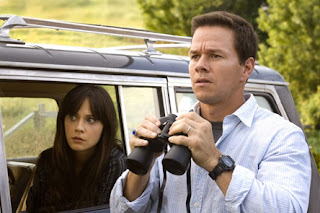
It's not easy, but the young director did follow it up with a string of beautifully crafted thrillers, arguably ending at "The Village." "Lady in the Water" wasn't a terrible film, but a very uninvolving and boring one. His effectiveness of tone couldn't save a simply dull story, and the movie was critically maligned on all fronts.
You'd think he learned a thing or two. "The Happening" isn't a disaster movie, it's a disaster. It is a collection of short, poorly-controlled scenes, almost progressively descending into a deeper level of badness and self-parody. His usual control of nuance and classical, sophisticated plotting is curiously gone and the film seems completely unaware of how bad it truly is.
The evil presence lurking in "The Happening" is a neurotoxin that interacts with the environment in unpredictable ways. When humans come in contact with it, they are driven to either apathetic, murderous or self-destructive impulses. The premise could have been used in a kind of neo-zombie way, like the "28 Days Later" movies, but is instead used only to show bizarre acts of random violence. With a darker tone, the idea could have been pretty scary, but in a blandly executed thriller like this, it is just boring.
The film has an eerie opening, but when the real story kicks in, things start crumbling down. Hopeless dialogue results in unfortunately bad performances from a talented cast. Mark Wahlberg is miscast and sadly laughable in most scenes and not much better can be said for John Lequizamo and Zoe Deschannel - who's cutesy presence in most movies is annoying in this one. It doesn't help that the failed marriage of the two main characters really feels more like a failed middle school romance. In this film, M. Night shows no greater insight into human relationships that an unintuitive, inexperienced student filmmaker - which is usually an area he is brilliantly astute with.
There were a few short moments that I remembered the promising auteur M. Night Shamylan once was. There is a scene that takes place in an unsold real estate property, complete with fake TV's, computers and dishes. Needless to say, the irony was clever and almost effective. Within the same scene, Mark Wahlberg's character starts having a conversation with a plant, exemplifying how most scenes in the film are ruined, no matter how promising.
With "Avatar: The Last Airbender" Shamylan will enter commercial territory that could be interesting. Why he fought to make such an uninspired thriller instead is beyond me.

It's not easy, but the young director did follow it up with a string of beautifully crafted thrillers, arguably ending at "The Village." "Lady in the Water" wasn't a terrible film, but a very uninvolving and boring one. His effectiveness of tone couldn't save a simply dull story, and the movie was critically maligned on all fronts.
You'd think he learned a thing or two. "The Happening" isn't a disaster movie, it's a disaster. It is a collection of short, poorly-controlled scenes, almost progressively descending into a deeper level of badness and self-parody. His usual control of nuance and classical, sophisticated plotting is curiously gone and the film seems completely unaware of how bad it truly is.
The evil presence lurking in "The Happening" is a neurotoxin that interacts with the environment in unpredictable ways. When humans come in contact with it, they are driven to either apathetic, murderous or self-destructive impulses. The premise could have been used in a kind of neo-zombie way, like the "28 Days Later" movies, but is instead used only to show bizarre acts of random violence. With a darker tone, the idea could have been pretty scary, but in a blandly executed thriller like this, it is just boring.
The film has an eerie opening, but when the real story kicks in, things start crumbling down. Hopeless dialogue results in unfortunately bad performances from a talented cast. Mark Wahlberg is miscast and sadly laughable in most scenes and not much better can be said for John Lequizamo and Zoe Deschannel - who's cutesy presence in most movies is annoying in this one. It doesn't help that the failed marriage of the two main characters really feels more like a failed middle school romance. In this film, M. Night shows no greater insight into human relationships that an unintuitive, inexperienced student filmmaker - which is usually an area he is brilliantly astute with.
There were a few short moments that I remembered the promising auteur M. Night Shamylan once was. There is a scene that takes place in an unsold real estate property, complete with fake TV's, computers and dishes. Needless to say, the irony was clever and almost effective. Within the same scene, Mark Wahlberg's character starts having a conversation with a plant, exemplifying how most scenes in the film are ruined, no matter how promising.
With "Avatar: The Last Airbender" Shamylan will enter commercial territory that could be interesting. Why he fought to make such an uninspired thriller instead is beyond me.
Saturday, June 7, 2008
Black Circle Boys

The best scenes of "Black Circle Boys" are of the film's wounded teenagers reacting to their turbulent lives in total isolation. The main character Kyle is a young man with a weak personal identification, mostly likely stemming from the distant relationship he has with his parents. Writer-director Matthew Carnahan allows these revelations to happen periodically and inductively. He directs such scenes in long takes, relying completely on the performances and nuance of the barren surroundings to bring forth the tensions boiling below the story's surface.
These few scenes are peppered in an otherwise flawed film which is melodramatic, implausible and disappointingly underdeveloped - giving the film a mysterious emotional undertone it doesn't follow through on. The opening introduces Kyle and his All-American swimming buddies wreaking antisocial havoc on the top of a building. Carnahan uses the POV of a videocamera, but stages the action awkwardly - rendering the whole approach of the scene useless. One pivotal detail in particular is extremely obscured, and that is the accidental death of one of Kyle's best friend who apparently falls off of the building.
The movie shifts into Kyle's new life in a new town and school. It becomes a traditional juvinile deliquency teen pic, throwing trite plot elements seen in most similar films from "Rebel Without a Cause" to "The Craft." Inevitably Kyle falls in with the bad kids, which in this case is a group of headbanging metal thrashers who call themselves the Black Circle Boys. Its leader Shane (Eric Mabius) is uncompromising, sociopathic, and slitheringly persuasive. The Black Circle boys turn out to be more than a fledgling metal band, and Kyle finds himself uncontrollably immersed in dangerous occult rituals and violent antisocial escapades.
The familiarities and annoyances of the film are largely to the fault of the script. While the style could have been glossy and dull like most teen pics of the time, it transcends the disappointing story with an unsettling conjuction of handheld cinematography and gritty art direction. Carnahan's direction is raw in a way few teen films were in 1997, because he meets the material with at least attempted realism and a very serious tone. However. he’s not consistently on his game throughout the film, and some scenes are bogged down from lazy direction.
The film is helped by a consistent and believable performance by Scott Bairstow. He is brooding, but likable and draws understanding to a character who makes progressively bad decisions. This is a weak, but all-around watchable teen drama that was a precursor to the realistic teen dramas of the 2000’s, like “L.I.E.,” “Bully” or “Mean Creek.”
Friday, May 30, 2008
Trash

Paul Morissey, more or less Andy Worhol's liscensed filmmaker, made interesting exploitation/arthouse films in the late 60's and 70's. The complete lack of classical aesthetic give his work an amateur feel, but he uses it to his benefit - exploring the bottom layers of society with fearlessly and boldly minimalistic flair.
His 1970 film "Trash" isn't a professional film by any measure. There is little (possibly zero) attempt at sound mixing, the acting is mostly bland (hacking the nuance of the script) and the editing and pace have no rhythm. However, the subject matter itself has an energy of its own and the film is able to shock and suprise despite being restrained by the production values and acting.
"Trash" is structured around a hustler named Joe (who was in Morrissey's previous film "Flesh") and his various encounters with different women. The first element anyone will notice is the graphic nudity used in the opening sequence. Used throughout the movie, the nudity is both provocative and absurdly comical, adding to and helping to create its tone of equal parts satire and drama. With Joe's aimless conversations, Morrissey is able to aim a critical eye towards Joe and the people he spends his time with. One particularly memorable moment of the film is when Joe stays with a strange couple who are clean of drugs, but not of other social/sexual perversions. We see that drugs are far from the only factor which inhibit and corrode dysfunctional modern lifestyles. Morrissey, supposedly anti-drug himself, does poke fun at and judge substance abuse, but in this film he uses them to show an intoxicated society, fixated on self-serving, shameless pleasure.
Monday, May 19, 2008
"Ticker"

Albert Pyun's films fill me with a weird sort of glee. The typical atrocity of the acting, generic scores, disconnected, usually hard-to-follow narratives, and stock footage are painted over with stylish, sometimes strikingly unique cinematography. The un-storyboarded compositions are sometimes dead on and other times aesthetically inept. He creates confusing, disoriented worlds - albeit in a very distinctive, memorable way. There is so much to look at in Pyun's more ambitious films, if one can bare the lack of substantial narrative quality.
Rumor has it that Steven Seagal had considerable control in the final product. His role as a bomb squad leader/zen philosopher is at least an attempt at making his character slightly different from any of those he has tried to play before. No matter what hand he had in this film, or how interesting the writers tried to make his character, he struggles with his performance. This movie has absolutely no effort, and is predictable despite the surprising potential.
For such a large cast and a sprawling story, Pyun does manage to keep things together in a linear fashion. The problem is that there are no memorable scenes or characters or anything. The special effects suck (look for the worst rear projection in movie history at the end, where cheap background video is used for hilarious contrast) and everything else is painfully mediocre.
Most people, no matter what profession, have dry spells of uninspiration and boredom. Every member of this film's cast and crew seem to be simultaneously experiencing such things in "Ticker."
For such a large cast and a sprawling story, Pyun does manage to keep things together in a linear fashion. The problem is that there are no memorable scenes or characters or anything. The special effects suck (look for the worst rear projection in movie history at the end, where cheap background video is used for hilarious contrast) and everything else is painfully mediocre.
Most people, no matter what profession, have dry spells of uninspiration and boredom. Every member of this film's cast and crew seem to be simultaneously experiencing such things in "Ticker."
Wednesday, May 14, 2008
a reflection on independent film
I am a big fan of premium cable movie channels - Cinemax, HBO, Starz, Showtime, Encore, they all have their charms. My favorite is Cinemax. I grew up with it and probably developed my interest in movies because of it. It helped me discover the, at the time, emerging world of independent film. I. film in the early to mid-90's was at its heyday of underground art, before the concept of independent film was commercialized by IFC, Sundance Channel, and eventually Hollywood conglomerations, who somehow found a way to buy out what started out as a counter movement to them. Almost every big studio has an indie production house. Look at last year's Best Pic Oscar nominations. The new American classics seen with PT Anderson's wonderful "There Will Be Blood" and the Cohen Brothers' masterwork "No Country For Old Men" were a product of indie subsidiaries. I can't criticize the fact that such unbelievably great films didn't go overlooked, as would usually happen to films of their nature. But I do think that the "Independent Spirit" seen with 80's and 90's mavericks like Jim Jarmusch has been forgotten about. Brilliant directors like Tom Dicillo are now having difficulty finding an audience for their films possibly because their charm as alternative filmmakers has become lost among mainstream-seeking tastes. The big indie films are all about auteurs and actors. Emerging voices, and truly independent voices of the past, are at a period in film history where content is either commercial or extremely diversified.
What does that say for the current film school generation of the 2000's? Its truly hard to tell. We've grown up watching auteurs like Quentin Tarantino, Wes Andersen, PT Anderson and Harmony Korine find large-scale success at very young ages. We all want what they earned, and the competition has never been so fierce. There has never been a period with more content providers and we have created a large mass with a very uncertain future. The technology is at our fingertips and we have never had greater access to influential films, which the advent of DVD and preservation societies like Janus Films are making widely available. As the future of exhibition is so clouded, there is no way to tell what kind of an industry us film students will be working in. All I know, is that it seems to be heading in a quickly rising new wave, putting independent film at ground zero once again.
What does that say for the current film school generation of the 2000's? Its truly hard to tell. We've grown up watching auteurs like Quentin Tarantino, Wes Andersen, PT Anderson and Harmony Korine find large-scale success at very young ages. We all want what they earned, and the competition has never been so fierce. There has never been a period with more content providers and we have created a large mass with a very uncertain future. The technology is at our fingertips and we have never had greater access to influential films, which the advent of DVD and preservation societies like Janus Films are making widely available. As the future of exhibition is so clouded, there is no way to tell what kind of an industry us film students will be working in. All I know, is that it seems to be heading in a quickly rising new wave, putting independent film at ground zero once again.
Subscribe to:
Posts (Atom)